


It can be challenging to determine the factors guiding Donald Trump one month after the American and Israeli campaign of military action on Iran.
However, it remains apparent he has his attention fixed on the global crude markets.
A comment – or tweet – from the American leader concerning his plans once would spark substantial fluctuations in oil prices, as market participants reacted to signs the conflict could worsen or conclude.
However, in recent days, market players are showing signs of becoming increasingly doubtful about the significance of his comments.
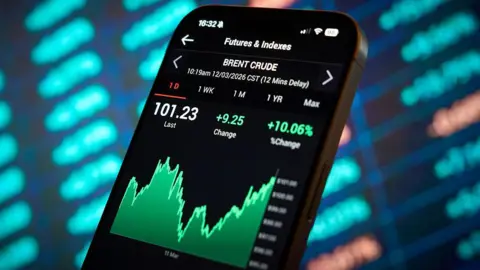
The price of oil was hovering around approximately $72 a barrel (bbl) prior to 28 February, when the strikes on Iran commenced.
Last week, it peaked at $118 a barrel on 19 March and as of Friday afternoon was sitting at just below $112 – markedly higher than its pre-conflict price.
The following are several examples from the past month where Trump and the markets appear to have influenced one another – with varying impacts.
Use the arrow to move to the next slide.
"Energy prices have acted as a barometer for broader political and financial uncertainties, surging when Trump's rhetoric grows aggressive and falling back when his rhetoric softens," observes one investment manager.
He states that financial markets are appropriately sensitive to those cues, considering the substantial financial dangers that accompany rising oil prices.
"Market participants are trying to price genuine risk," he explains. "The markets can appear nervous or uncertain, but what they're actually attempting is handling event risk in live, with oil acting as the core of that."
However, it can be tough for traders to determine how to trade, especially since some of Trump's remarks appear aimed at moving oil prices, as opposed to articulating policy, notes another financial strategist.
"As the saying goes, the first casualty of war is clarity," he remarks. "My belief is much of the rhetoric back-and-forth around successful negotiations, and the contrary, very much are focused on simply shifting the market price of oil."
Market Reactions Become Increasingly Muted
On Thursday, minutes after US stock markets recorded their sharpest fall since the beginning of the conflict with Iran, Trump announced talks with Iran were going "very well" and he was putting off planned attacks on Iran's oil facilities until at least 6 April.
However, the price of crude proceeded to rise.
One head of FX strategy points out that investor responses are "growing increasingly subdued" because of the "wide divergence" between Trump's optimistic statements and the absence of acknowledgement from Tehran.
"Considering the appearances, many market watchers do not foresee an early conclusion to the conflict and financial markets continue to be anxious."
Another investment director comments markets have also adapted to Trump "often shifting position at hints of geopolitical, equity market or economic trouble".
"There is a level of doubt, or even frank suspicion, creeping in at the fringes," he adds.


